Pages

Showing posts with label Quaid. Show all posts

Thursday, 6 March 2014

Todays Number Quaid

Today’s Number:
136
Write it in words
one hundred and thirty six
Write it as an expanded number
100+30+6
Add 3
139
+ 25
161
Subtract 5
131
- 17
119
Next 3 even numbers
138, 140, 142
Double it
272
Last 4 odd numbers
135, 133, 131, 129
Half of it
68
10% of it is
13.6
25% of it is
34
⅓ of it is
45.333333
Multiply by 6
816
MUltiply by 4
544
Divide by 4
34
÷ by 6
22.6666666
This is my Todays number result for today. I got all of them right. Please leave a comment on my blog.

Monday, 24 February 2014

How can the contents help

How the contents can help


L.I. - Library/Research skills
How to use the contents page to research effectively


The table of contents lists the chapters and other main parts of the book.  It is helpful because it gives you a general idea about the book so you know which chapters apply to your research.  Below is an example from a book about the moon.


Table of Contents


Introduction                                                                                                                                              1
Chapter 1      The size of the moon in relation to the earth                                                            5
Chapter 2      How the moon influences Earth’s tides                                                                      17
Chapter 3      Full, half, and quarter moons                                                                                        31
Chapter 4      The lunar landscape: craters, mountain ranges, plains and faults                       45
Chapter 5      The maria of the moon                                                                                                   57
Chapter 6      Theories about the origins of the moon                                                                      69
Chapter 7       Lunar geology                                                                                                                  77
Chapter 8       The moon and the age of the telescope                                                                    89
Chapter 9       Spacecraft and their impact on our knowledge of the moon                               103
Chapter 10     The Apollo programme                                                                                                   119
Index                                                                                                                                                            135


Before you start highlight 4 words you don’t know and look them up in the dictionary.
LUNAR-of the moons
INFLUENCE- to have an effect of a character
MARIA - Large dark flat areas of the moon


Answer these questions from the contents page above:


Which two chapters will have the most information about human beings travelling to the moon?
Chapter 9 and 10
Which three chapters will tell you about aspects of the moon in relation to the earth? Chapter 1, 8, 9
Which three chapters will tell you things about the surface of the moon?
Chapter 4, 5 , 7


Which chapter will tell you the most about the Earth’s tides? Chapter 2

Xtramath Quaid

This is my Xtramaths result screenshot. I am getting better than last week. I will try harder to get a higher score

Thursday, 13 February 2014

Quaid - Xtramaths

Here is my Xtramaths result. I just need a couple more equations for me to be on the next level. Please leave a comment

Friday, 7 February 2014

Quaid - Film strip

This is my Film strip. It is All About me . Please leave a comment

Todays Number

Today’s Number:
360


Write it in words
three hundred and sixty
Write it as an expanded number
300 + 60
Add 3
363
+ 25
385
Subtract 5
355
- 17
343
Next 3 even numbers
362, 364, 366
Double it
720
Last 4 odd numbers
359, 357, 355, 353
Half of it
180
10% of it is
36
25% of it is
90
⅓ of it is
120
Multiply by 6
460
x by 4
2160
Divide by 4
1440
÷ by 6
90

I need to work on dividing tree digit numbers.
The hardest part was dividing it by 6.
The easiest part was expanding the number.

Monday, 14 October 2013

Library Skills - Using Te Ara


Using Te Ara -
The Encyclopedia of New Zealand
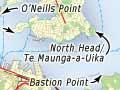
1. Waitemata Harbour

L.I. Develop our knowledge of Auckland and the Tamaki River.
Familiarise ourselves with an online NZ encyclopaedia.
Use our skimming and scanning skills.

Use this link to open Te Ara
Enter Waitemata into the search box and use that page to answer these questions.

What sort of landform is the Waitemata harbour?
The Waitemata Harbour is a drowned river valley.

Why was it chosen to be New Zealand’s capital?
Because it is a navigable channel and its sheltered bays helped to determine Lieutenant-Governor Hobson’s choice of a site for New Zealand's capital in 1840.

What does Waitemata mean?
Waitemata means obsidian waters - The glassy surface known as obsidian rock.

Tell me one interesting fact about each of these features of the Waitemata-It has tidal flats and mangroves in the upper reaches to the west, and sandy bays with sandstone cliffs along the eastern shores.

Auckland’s chief port -By 1900, 132 acres (53 hectares) of land had been reclaimed from the harbour.

Viaduct basin -The Viaduct Basin, site of the old fishing harbour, was redeveloped in the mid-1990s as a site where the Royal New Zealand Yacht Squadron could host the America’s Cup in 1999 and 2003.

Westhaven -The Westhaven Marina, with 1,800 berths, is the largest managed marina in Australasia, and a symbol of Aucklanders’ love of sailing.

Harbour bridge -It was the last bridge in the world constructed with a steel lattice girder.

Greenhithe bridge - The Greenhithe Bridge was built in 1975 as an alternative harbour

Natural features -It was formed by lava flowing from the Three Kings eruption 20,000 years ago.

Map


Thursday, 1 August 2013

200`s Numbers frame activity.


We had to select a diagonal pair and then add it all up. The answer is the same!
This works with every diagonal lines because the tens & hundreds are the same digits but the ones digits are just reversed.

Thursday, 18 April 2013

Charge of the Light Brigade


The Charge Of The Light Brigade  
Alfred Lord Tennyson
By Quaid Fletcher
LI: to understand the story behind this narrative poem


Half a league, half a league,
     Half a league onward,
All in the valley of Death
     Rode the six hundred.
'Forward, the Light Brigade!
Charge for the guns!' he said:
Into the valley of Death
     Rode the six hundred.
'Forward, the Light Brigade!'
Was there a man dismay'd ?
Not tho' the soldier knew
     Some one had blunder'd:
Their's not to make reply,
Their's not to reason why,
Their's but to do and die:
Into the valley of Death
Rode the six hundred.

Cannon to right of them,
Cannon to left of them,
Cannon in front of them
     Volley'd and thundered;
Storm'd at with shot and shell,
Boldly they rode and well,
Into the jaws of Death,
Into the mouth of Hell
     Rode the six hundred.
Flash'd all their sabres bare,
Flash'd as they turn'd in air
Sabring the gunners there,
Charging an army, while
     All the world wondered:
Plunged in the battery-smoke
Right thro' the line they broke;
Cossack and Russian
Reel'd from the sabre-stroke
     Shatter'd and sunder'd.
Then they rode back, but not
     Not the six hundred.
Cannon to right of them,
Cannon to left of them,
Cannon behind them
     Volleyed and thundered;
Stormed at with shot and shell,
While horse and hero fell,
They that had fought so well
Came thro' the jaws of Death,
Back from the mouth of Hell,
All that was left of them,
     Left of six hundred.
When can their glory fade ?
O the wild charge they made!
     All the world wondered.
Honour the charge they made!
Honour the Light Brigade,
     Noble six hundred!


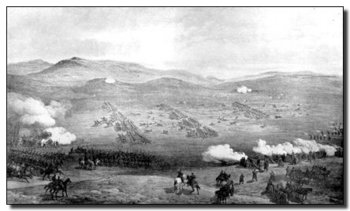
At the Battle of Balaclava in 1854 during the Crimean War, the ‘Light Brigade’, (a group of British soldiers), charged down a narrow valley to fight the Russian soldiers who had captured British guns. The Russians were at the end of the valley as well as on each side of it. The attack was not a wise choice and happened because of a misunderstanding of an order sent by the commander-in-chief. After following orders less than a third of these men survived.

Answer these questions in full sentences:

“If you were in the military and you were given an order, would you obey it – even if it meant putting your life on the line?  Why or why not?”        
Yes I would because otherwise they might decide to punish you.

What is a brigade?
A subdivision of an army, typically consisting of a small number of infantry battalions and/or other units and often forming part of a division: "he commanded a brigade of 3,000 men".
“Theirs not to make reply/Theirs not to reason why/Theirs but to do and die” - What did this mean for the soldiers?
It might be a leader saying it and  if they don't follow they can also be punished.
stor
What makes this a narrative poem?
A narrative is a fairy tale and made up of fantasy creatures

A narrative poem is  a form of poetry which tells a story, often making use of the voices of a narrator and characters as well.

Read the poem again and answer these questions about the language used:
LI: To explore the language of a narrative poem

Stanza 1:
What does the Valley of Death mean?A place of where people lay dead
Who is “he” in line 6? The Commando
What is the six hundred referring to? 600 soldiers and there horses of course

Stanza 2:
Now that you see it in context, what does the line, “Theirs but to do and die” mean?
Go do it, listen to the commando and die.


Stanza 3:
What weapons are used against the Light Brigade?Guns cannons

What two things are personified here? JAWS OF DEATH and MOUTH OF HELL.


Stanza 4:
Did the Light Brigade win or lose? Lose
Are they seen as heroes?Yes


Use short answers to answer the following questions.
LI: To show that I am reading for meaning and understanding  
About how many soldiers were in the Light Brigade? Six Hundred

What weapons did they carry?Sabre(sword)
 
What weapons did they face? Cannons Guns

Why did the Light Bergade Charge?They were told too

How are they survived of the Light Bergade at the end of the poem?


Click on the link on the picture to help you find your information


List 3 facts about the poet Alfred Lord Tennyson
Death
He died in 1892 (83) and was buried in We
stminster Abbey.

In 1833 (24) Hallam made a trip abroad with his father, and died suddenly in Vienna, an event which had a profound emotional impact on Tennyson, and led him later to write some of his most memorable verse, including In Memoriam, Ulysses, Tithones and the Passing of Arthur.

In 1831 (22) Tennyson’s father, who had returned home, died.
By Quaid Fletcher